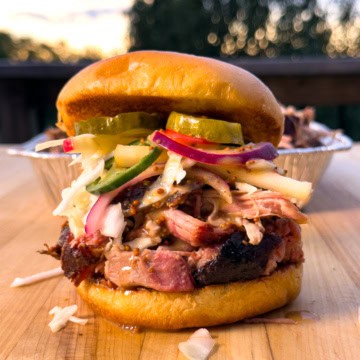
Smoked Maple-Mustard Pulled Pork Shoulder with Apple Slaw
Crackling, deep-mahogany smoke bark meets rich, succulent pork, all brought to life by the snappy bite of whole-grain mustard and the sweet warmth of pure maple. This dish takes low-and-slow barbecue and balances it with bright, clean flavours, so every single bite stays vibrant. Instead of hiding the meat under heavy, sugary barbecue sauces, we build layers of genuine flavour from start to finish. We start with a dry brine to keep the meat incredibly juicy, smoke it unwrapped on the Weber Smoque to build a thick, savoury crust, and finish it with a simple maple-mustard sauce that lets the hardwood smoke shine. Piled high on a toasted brioche bun with a quick homemade apple slaw, this is pure barbecue perfection straight from the smoker.Total scheduling window: Allow approximately 11 to 15 hours from lighting the smoker to serving
Ingredients
Pork Shoulder
➡️Note on Scaling the Recipe: When scaling to 2X or 3X, the light grey ingredient notes and the instructions remain unchanged. Please adjust as needed.
- 1 bone-in Boston butt/pork shoulder 7 to 8 lb (3.2 to 3.6 kg), preferably unenhanced
- 15 g kosher salt approx. 2½ tsp, for dry brining
- 2 tablespoon Dijon mustard for a binder, optional
Pork Rub
- 2 tablespoon sweet paprika
- 1 tablespoon smoked paprika
- 1 tablespoon packed dark brown sugar
- 1 tablespoon coarsely ground black pepper
- 2 teaspoon garlic powder
- 2 teaspoon onion powder
- 2 teaspoon dry mustard powder
- 1½ teaspoon ground coriander
- ½ teaspoon cayenne pepper
- Note: Do not add extra salt to this rub.
Maple Mustard Finishing Sauce
- ⅓ cup pure maple syrup 80 ml
- ⅓ cup Dijon mustard 80 ml
- ¼ cup apple cider vinegar 60 ml
- 2 tablespoon whole-grain mustard
- 1 tablespoon Worcestershire sauce
- ½ teaspoon freshly ground black pepper
- ¼ teaspoon cayenne pepper
Tangy Apple Slaw
- 5 cups finely shredded green cabbage
- 1 large crisp apple such as Honeycrisp, Granny Smith or Pink Lady, julienned
- ½ small red onion very thinly sliced
- 1 jalapeno very thinly sliced, optional
- 1 Finger red chili very thinly sliced, optional
- 3 tablespoon apple cider vinegar 45 ml
- 1 tablespoon pure maple syrup 15 ml
- 1 tablespoon Dijon mustard
- 2 tablespoon extra virgin olive oil
- ½ teaspoon kosher salt
- ¼ teaspoon freshly ground black pepper
For Serving
- 10 to 12 brioche or potato buns
- Unsalted butter softened (for toasting)
- Dill pickle slices
Instructions
The Day Before - Trim and Dry Brine
- Check your pork shoulder label to ensure it has not been enhanced or pre-injected with a salt solution. (If it's too late and you are using an enhanced shoulder, don't add the full 15 g of extra salt.)
- Pat the pork dry with paper towels. Trim away loose flaps of meat and hard exterior fat that won't render. Trim the main fat cap down to roughly ⅛ to ¼ inch (3 to 6 mm). Don't remove every trace of exterior fat, but prioritise leaving meat exposed because that surface develops valuable bark.
- Distribute the 15 g of kosher salt evenly over every surface of the pork.
- Place the shoulder uncovered on a wire rack set over a rimmed sheet pan and refrigerate for 12 to 24 hours. Do not rinse the pork before cooking.
What is Dry Brining? Dry brining is the process of salting meat hours before cooking. Salt draws out natural moisture, dissolves, and then reabsorbs deep into the muscle tissue, seasoning the pork thoroughly while improving juice retention.
Season the Pork
- Remove the pork from the refrigerator 30 to 45 minutes before smoking.
- Whisk all Pork Rub ingredients together in a small bowl.
- We didn't use or need a binder, but you can spread a thin layer of Dijon mustard over the pork to act as a binder for the rub.
- Generously sprinkle the rub on all sides, pressing the spices gently into the mustard so they stick.
Set Up the Weber Smoque Pellet Grill
- Ensure the smoker is clean and the grease tray is clear. Fill the hopper with fresh hardwood pellets (apple wood or a GrillMaster blend works exceptionally well here).
- Set the smoker to SmokeBoost mode.
- Insert a leave-in meat probe horizontally into the thickest part of the shoulder, keeping the tip clear of the bone and large seams of fat.
TIP: Avoid an extremely assertive smoke profile. We want pronounced smoke, but maple and mustard still need to register in the finished pork.
Initial Smoke
- Place the pork shoulder directly on the grate, fat-cap side down.
- Close the lid and smoke using SmokeBoost for 2 hours.
- Keep the lid closed. Do not spritz, mop, or turn the meat during this period; keeping the surface dry helps form a thick bark.
Cook at 275°F (135°C)
- Increase the Weber Smoque temperature to 275°F (135°C).
- Continue cooking unwrapped with the lid closed. The surface will transition into a deep, dark mahogany crust.
- When the internal temperature hits the 150s–170s°F (65–77°C) range, the cook will slow down. This is the natural stall; stay patient and continue cooking unwrapped at 275°F (135°C).
Bark Check & Optional Butcher Paper Wrap
- Around 165–175°F (74–79°C) internal, check the exterior. The bark is ready when it is mahogany to dark brown, dry to the touch, and seasoning has formed a defined crust.
- Preferred Method: If the cook is progressing reasonably and the bark is not becoming excessively dark, leave the pork unwrapped for the entire cook. Continue at 275°F until the pork approaches 195°F internal temperature. At that point, stop relying solely on the leave-in probe and begin checking the shoulder manually for tenderness.
- Optional Wrap: Only wrap if the bark is getting too dark, the stall is unusually prolonged, the weather is substantially extending the cook, or you need to speed up the timeline for your serving schedule.Once the bark is fully set, tightly wrap the shoulder in two overlapping sheets of unwaxed, food-safe butcher paper. Do not add apple juice, cider, butter, maple syrup or other liquid. Return the wrapped shoulder to the smoker at 275°F. Reinsert the probe through the paper without creating unnecessary openings. Continue cooking until probe tender.
- If Severely Behind Schedule: Foil will accelerate the cook more aggressively than butcher paper, but it will soften the bark more. Use foil only as a schedule-rescue technique, not as the preferred method.
TIP: If those conditions have not been reached, continue cooking unwrapped. Internal temperature does not determine whether the bark is ready.
Test for Doneness
- Begin checking for tenderness around 195°F (90°C) internal. Probe multiple areas: the centre of the largest muscle, around, but not against, the blade bone, and at least two additional thick areas.
- You are looking for a sensation similar to inserting the probe into very soft butter. The blade bone should also feel loose when gently moved.
- Most shoulders become probe-tender between 198°F and 205°F (92°C to 96°C). The blade bone should wiggle easily when pulled gently.
What is Probe Tenderness? Internal temperature is only a rough guide. Pork shoulder is properly finished when a probe slides into the thickest sections with practically zero resistance, feeling just like warm butter.
Probe tenderness is the target. If the pork is 203°F but still noticeably resistant, continue cooking. If it is exceptionally tender at 199°F, it is done.
Rest
- If Cooked Unwrapped: Transfer to a rimmed pan, loosely tent with foil or butcher paper, and rest for 45 to 60 minutes.
- If Cooked Wrapped: Vent the paper open for 3 minutes to stop the cooking process, rewrap, and rest in an insulated cooler or warm oven for 1 to 2 hours.
TIP: Do not immediately pull a shoulder straight from the smoker without resting.
Make the Finishing Sauce & Slaw
- Sauce: In a small saucepan, whisk maple syrup, Dijon, apple cider vinegar, whole-grain mustard, Worcestershire sauce, black pepper, and cayenne.Simmer over medium-low heat for 3 to 4 minutes. Remove from heat. Whisk in 2 to 4 tablespoons of defatted juices if collected from the rested pork.
- Slaw: In a large bowl, whisk the cider vinegar, maple syrup, Dijon, olive oil, salt, and pepper. Toss in the green cabbage, julienned apple, jalapeño, finger red chili and sliced red onion. Let stand 15 to 20 minutes before serving.
Pull, Season & Serve
- Place the rested pork on a tray or cutting board and remove the blade bone. It should release cleanly with almost no resistance.
- Using gloved hands, gently separate the meat along its natural muscle structure.
- Pull into substantial, juicy pieces rather than fine shreds. Break up the bark and mix it into the pulled pork.
- Toss the pork with ⅓ cup of the finishing sauce. Taste and add additional finishing sauce 2 tablespoons at a time, up to approximately ½ cup total, until the maple-mustard character is clearly identifiable but the pork still tastes primarily of pork and smoke.
The finished pork should be: juicy, glossy, smoky, lightly tangy, distinctly savoury and subtly maple-mustard forward. It should not look wet or heavily sauced. Taste for salt only after the sauce and juices have been incorporated.
Toast the Buns
- Lightly butter the cut surfaces of the buns with unsalted butter. Toast until golden.
TIP: This is not merely decorative. The toasted surface provides texture and helps prevent the bun from immediately absorbing the pork juices and sauce.
Assemble the Sandwiches
- For Each Sandwich: Toasted bottom bun, generous mound of Maple Mustard Pulled Pork, small drizzle of Maple Mustard Finishing Sauce, Tangy Apple Slaw, Dill pickle slices and the toasted top bun.
- Do not overload the sandwich with finishing sauce. The smoked pork remains the focal point. Serve additional sauce alongside.
💬Tried this Recipe?
- We'd really appreciate a rating and a quick review! It helps more home cooks find the recipe, and we love hearing what you think.
Video
Tried this recipe?Let us know how it was!